Explore
Ecology and stewardship
A tidal estuary, a marsh, a forested ridge and a great many visitors in the same few miles. What stewardship means here, and how to take part in it.
Human and natural ecosystems do not function independently — they co-exist in one integrated ecology.
That principle is easy to write and hard to build. This corridor holds a tidal river, a creek and marsh system, a steep forested ridge, a live railway and a state highway, in a strip a few hundred yards wide — and it already receives more visitors than its trails were built for. The Fjord Trail is, among other things, an attempt to route those visitors deliberately rather than let them find their own way across a fragile hillside.
A tidal river
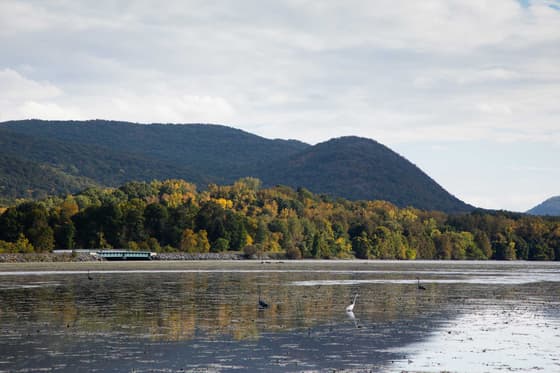
The Hudson at Beacon is a tidal estuary: the water at the shoreline rises and falls twice a day, and the marsh reaches of the trail are built in that zone. NOAA publishes tide predictions for a station at Beacon, and we carry a year of them in the offline pack — a detail that matters if you are planning to be at the water's edge.
The Eco-Stewards
HHFT runs volunteer Eco-Steward work days through the season: habitat work, invasive species removal, planting and monitoring, led by staff. It is the most direct way to be part of this corridor before there is a trail to walk on, and no experience is needed.
-
Mid-week planting morning
Little Stony Point — Meet at the Little Stony Point parking area on Route 9D.
A short weekday session for volunteers who cannot make a Saturday. Shoreline planting near Little Stony Point.
-
Eco-Steward work day
Little Stony Point — Meet at the Little Stony Point parking area on Route 9D. Look for the HHFT banner. Parking there is limited and fills early on summer weekends; the walk from Cold Spring station is about a mile along the road shoulder, so arriving by train means allowing 25 minutes on foot.
Volunteer habitat work with HHFT staff along the corridor: invasive removal, planting and site care. No experience needed; tools and gloves provided.
-
Eco-Steward work day
Little Stony Point — Meet at the Little Stony Point parking area on Route 9D. Look for the HHFT banner.
The September work day: autumn planting and invasive removal along the corridor, with HHFT staff. No experience needed.
Volunteer with the Eco-Stewards
The environmental review
This project went through a full State Environmental Quality Review. The Final Generic Environmental Impact Statement was accepted by the Office of Parks, Recreation and Historic Preservation as lead agency on 7 January 2026, and the Findings Statement followed. Those documents — several hundred pages and a large volume of appendices — are the reason we can be as specific as we are about lengths, widths, restrooms and parking counts.
They are kept in the archive, at permanent URLs. As of May 2026 the review is the subject of active litigation. Content that is the subject of litigation is not content to quietly delete, and it stays where it can be found.
Information
Demonstration content
HHFT's ecology team writes this page. The structure here shows the interpretive template — pull quote, sections, live event list, document links — with content assembled from public documents.
Last reviewed